APAG - American Photography Archives Group
  • Home
  • About
    • APAG Board
  • Membership
    • Members Only
  • News
  • Resources
  • Members Gallery
  • Conference
  • Education
  • Contact

Charlotte Brooks

Posted on May 3, 2013 by APAG in Member Profile


CONTACT: Annekingmanpage@gmail.com

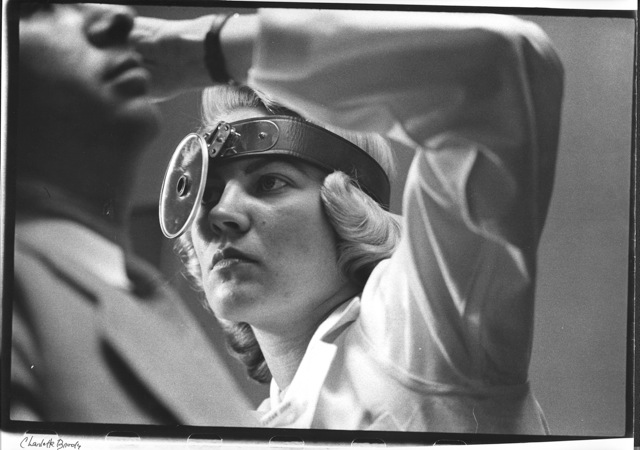
Charlotte Brooks is a photojournalist who worked for LOOK magazine
from 1951 until 1971 and was the only long-term woman staff photographer during LOOK’s 35 year history. As a “sociologist with a camera” Brooks’ thoughtful photographs document the changing face of America in the 1950’s and 1960’s.

Brooks was born charlotte Finkelstein on September 16, 1918 in Brooklyn, New York where she grew up graduating from Erasmus Hall, Brooklyn College and later attended University of Minnesota.

Charlotte returned to New York to further pursue her childhood interests in photography and dance. She studied with Bernice Abbott at the New School for Social Research and in 1942 got a job combining both her
passions assisting photographer Barbara Morgan, famous for her images of modern dance pioneer Martha Graham. In 1943 she became Gjon Mili’s assistant and became well versed in his Modernist style. She branched out on her own in 1944 and after her images were brought to the attention of Roy Stryker she joined his project at Standard Oil of New Jersey documenting in photographs the story of oil during World War II. The job ended in 1946 when Stryker’s FSA team returned from war.

After freelancing for the next three years, her friend Arthur Rothstein
introduced her to the people at LOOK magazine in 1951 where she remained until its demise in 1971. As a female magazine staff
photographer at that time, Brooks broke ground and changed the workplace for future women photojournalists. When she joined
the American Society for Magazine Photographers she was only one of three female members. In 1953 she served as its secretary and
vice-president in 1955 and negotiated hard to change the gender differential in pay.

In the years following LOOK Charlotte conducted photography workshops for the U.S. State Department in Romania and Soviet Georgia in the mid-1970’s and held classes for teenagers at a local community center.

Albert Dixon Simmons

Posted on May 3, 2013 by APAG in Member Profile
Bird Rock Puffins, 1937
Wings Against the Wind, 1935
Net Mending, 1958

Easy Catch, 1937
Westport Tuna Derby, 1940
Great Blue Heron, 1935

Albert Dixon Simmons, naturalist, outdoors photographer, author, and guide

Archive Representative: John W. Flynn, Jr. adsimphoto@gmail.com

https://www.fastcatchpress.com

Albert Dixon Simmons (1892-1972) was a pioneer in nature action photography and filmmaking, their use in studying the flight mechanics of birds, and the use of Kodachrome color films.  He authored two photography books in association with noted sporting genre publisher and editor Eugene V. Connett III.

A native of Prince Edward Island and 1916 M.I.T. graduate (Architecture), the Great Depression forced a career reset and focus shifted to his passion for the outdoors, at first using cameras to reveal the technical nuances of avian flight.  Adapting a camera mount to a rifle stock with open gun sights, Simmons “shot” fast-moving birds in flight, with revealing slow motion footage, and elegant images from 35mm negatives collectively published as Wing Shots (1936, Derrydale Press, NY).  With its release noted by Time magazine, each of the 83 images was a gravure print made from a corresponding mounted, titled and signed black & white photograph, but no text beyond the contents and Forward pages.  Selected images were included in Leica’s promotional touring exhibits, the 1937 Leica Annual, and Leica Manual, print ads, and articles he published in Nature and Field & Stream magazines.  In 1936, he also became involved with the first generation of Kodachrome transparency and motion picture films, traveling to the US Gulf Coast and, in 1937, to Bird Rock (Rochers aux Oiseaux) in Canada, to document migratory species with some of the first color transparencies and films of birds in the wild.

Wing Shots images comprise nearly all of Simmons’s signed printed works; he made only a few personal prints from Bird Rock images and a handful of prints after the 1930s, preferring transparencies for slide show presentations.  He continued to write and photograph commercially for wartime and sporting publications and equipment manufacturers, was Outdoors editor for the Cleveland News, provided radio commentary, and maintained relationships with the Cleveland Zoo and Cleveland Museum of Natural History throughout his life.  He contracted as guide/photographer for hunting and fishing expeditions, with the experiences from Alaska to Africa culminating in Photography for Sportsmen (1951, D. van Nostrand, NY), a detailed how-to guide for nature and outdoors photographers and filmmakers.

Each year, Simmons and his wife summered in her native Nova Scotia, combining family, friends, and work, until his death there in 1972.  His cameras and extensive library, many negatives, transparencies, prints, and motion pictures, were sold, given away, or misplaced in the ensuing years, but the majority of original Wing Shots negatives and many early Kodachromes, as well as unpublished images depicting Maritime province life in the 1950’s and early ‘60s, were kept by his daughter but remained idle for decades.

The chance discovery in 2011 of a manuscript about Bird Rock, hand-assembled by Simmons and begun over 70 years earlier, confirmed a family rumor that, in his last years, he was attempting to complete a third book, though nothing was found after his passing.  Early in 1972, in failing health, Simmons had sent the manuscript to the colleague who accompanied him to Bird Rock thirty-five years earlier, in 1937, as a gesture of friendship and thanks.  Amazingly, through charmed kismet and the internet, it joined the rest of the Simmons archive, which is managed by his grandson.

The George Eastman House keeps a small number of Simmons’s transparencies in its permanent collection as examples of first-generation Kodachrome and glass slide mounting technique.


Regina Monfort

Posted on May 3, 2013 by APAG in Member Profile


Sweetie and Sonya on Borinquen,Brooklyn, New York, 1999


Contact: regina.monfort@icloud.com / www.reginamonfort.com

Born in 1958 in Saint-Brieuc, France, Regina Monfort left home at a young age, compelled to expand her horizons. Her love for black-and-white cinematography drove her to study photography. In 1984, after graduating from L’Ecole de Photographie de la Ville de Bruxelles, Monfort left Europe for the United States. Not interested in pursuing a career in commercial photography, she worked as an assistant photographer at the Dallas Museum of Art and later as a museum photographer for the Yale University Art Gallery. On her time off, Monfort pursued her own work with the nude figure and experimental portraiture. In 1990, shortly after moving to New York she became employed at the Irving Penn Studio where she spent seven years working closely with the photographer’s print archive.

In 1994, Monfort began photographing young people from the Puerto Rican and Dominican communities of Brooklyn’s Williamsburg section. It is then that she recognized a passion for working in the documentary mode. In 1997, an essay titled, “Growing up in Brooklyn,” appeared in CultureFront Magazine. Later that year, Monfort received a prize from the Columbia School of Art resulting in an exhibition in the New York City subway. In 1998, her work was nominated for the Human Spirit Essay category as part as the annual Alfred Eisenstaedt Award in Magazine Photography. That same year, with grants from the Department of Cultural Affairs and the New York State Council on the Arts, Monfort produced outdoor slide shows in the communities she documented.

Monfort’s photographs have been exhibited at the Brooklyn Public Library, the Columbia University School of Social Work, Fotoseptiembre, Kansas State University, Lianzhou International Photo Festival, the Museum of the City of New York, The New York Public Library, PhotoEspana, Soros Open Society Institute and in the New York City Subway among other venues. Selected works are in the permanent collections of the Brooklyn Museum, the Brooklyn Public Library, the Library of Congress, the Museum of the City of New York, the New York Public Library and the Yale Art Gallery. Her work has appeared in DoubleTake, French Elle, El Diario, the Children’s Beat, Mixt(e), Newsday, Photo District News, The Source, The Village Voice and a number of cultural and scholarly publications.

Monfort has taught at CUNY La Guardia Community College, Pratt Institute and the School of the Art Institute of Chicago. Her interest in the preservation of photographic legacies has brought her to work with a number of archives. From 1997 to 2003 she was assistant director on Contacts -a French documentary film series exploring the work methods of established photographers. Monfort’s other documentary projects include North High School, Iowa, 1999: Revisiting notions of identity, alienation and belonging in America at the turn of the century; Methamphetamine Addiction in the American Heartland, Kansas, 2004 and the Bronx Riviera: a cultural love affair.

Bedrich Grunzweig

Posted on April 15, 2013 by APAG in Member Profile


Bedrich Grunzweig
American, b. Prague, 1910 – 2009
Archive contact: Ruth Grunzweig Roth 212.838.9368 GrunzweigPhotography@Ymail.com
Vintage prints: Margit Erb, Howard Greenberg Gallery, New York City 212.334.0010 margit@howardgreenberg.com

Bedrich Grunzweig was born in 1910 in Prague and grew up in Brno, Czechoslovakia. Following university studies and service in the Czech army, he took an administrative post in a sugar mill. In 1939, he escaped from Nazi-occupied Czechoslovakia with his first wife, Judith Winterstein. His grandmother, parents and older brother, Hans, were all murdered by the Nazis. Bedrich’s first photograph, made in 1926, was a portrait of Hans.

Arriving in the U.S., he settled permanently in New York City, whose architectural forms, visual excitement and relentless pace would inform and inspire his photography throughout his life. Following a job at the Czech Pavilion of the 1939 World’s Fair and service with the wartime Czech government-in-exile, he joined the newly formed United Nations where he worked until his retirement in 1974. In each case, he worked in the field of communications, media and public information. In 1961, he served for nine months in a leadership role at the UN peace-keeping operation in the Congo.

Since the 1940s, Bedrich Grunzweig had been photographing life in a wide range of locations, with a particular interest in his adopted hometown, New York City. His best known images include “Between Heaven and Earth,” a spectacular shot of a window cleaner at the United Nations building which won U.S. Camera magazine’s first prize in 1951, as well as being published in Popular Photography’s 1952 Annual and in the 1952 Annual of American Photography.

In 1964, he won the Saturday Review first prize for his photograph of architect Eero Saarinen’s ground breaking TWA Terminal at Kennedy Airport. In 1973 his work was exhibited at the solo show “Return to Prague: A Personal Sojourn” at the Jewish Museum in New York City and at the Koffler Centre for the Arts in Toronto.

After retirement from the UN, Grunzweig became adviser to International Center of Photography (ICP) founder and director, Cornell Capa, from 1974 to 1994. He worked with new photographers, curated photo exhibits and, in 1984, was invited by the ICP to exhibit a one-man show of his photos. Describing Grunzweig’s work, Cornell Capa said, “Through his life span, he has seen much. He has gentle humor, and great sensitivity to the human tragedy.”

Grunzweig returned to Prague, the city of his birth, three times between 1969 and 1983 and again in 1991 and in 1998. This last visit marked the opening of the one-man retrospective show “Between Heaven and Earth”, Grunzweig’s first exhibit in the city of his birth.

In his later years, Grunzweig had a solo show at New York’s Leica Gallery and a solo retrospective of his New York City photographs at John Stevenson Gallery. His photograph, “Home From Work” was featured on the exhibit poster for the 1998 retrospective “Eight Million Stories: 20th-Century New York Life in Prints and Photographs from the New York Public Library”. Grunzweig ‘s work continues to be represented by New York’s Howard Greenberg Gallery.

In addition to documenting life in New York City, Grunzweig traveled and photographed in diverse locations, including the American Rockies, Congo, Czech Republic, Israel, Vermont, Toronto, Mexico, and more.

His work can be found in the collections of numerous museums and institutions, including the New York Public Library, the United Nations Photography Archives, The Museum of Modem Art (New York-NYC), the Metropolitan Museum (NYC), the International Center of Photography (NYC), the Cooper-Hewitt Museum (NYC), the Seagram’s Photo Collection (NYC), the Library for the Performing Arts (NYC), the Jewish Museum (NYC), the Israel Museum (Jerusalem), the University of Haifa, the Museum of the Jewish Diaspora (Tel Aviv), and the Moravian Museum. He is listed in the Auer & Auer and George Eastman House databases.

Bedrich Grunzweig died on February 21, 2009, just short of his 99th birthday. He is survived by his wife Ann Roudebush Grunzweig, daughter Ruth Grunzweig Roth, grandsons S. Adam Roth and A. Daniel Roth and son-in-law, J. Lipa Roth.

Sol Prom

Posted on April 13, 2013 by APAG in Member Profile


Sol Prom is the photographer pen name of Solomon Fabricant (1906 – 1989). He joined the New York Photo League when he was in his early 30s while he was working on his doctorate in Economics at Columbia University. A serious amateur photographer, he was typical of most members of the Photo League–a first generation Jewish-American who had attended public school and City College before going on to graduate school.

Throughout his life, both early on in his photographs, and later as a prominent economist, he was concerned about the human condition and was committed to bringing about social reform. Starting as a research assistant, he rose to become Director of Research at the National Bureau of Economic Research where he did pioneering research on the measurement of productivity. He was also a Professor of Economics at New York University and served on many private and governmental commissions and boards.

He was a member of the Photo League between 1936 and 1939 and worked with the Feature group on three projects: “Park Avenue North and South”, “Dead End: the Bowery”, and “Harlem Document.” Having a life-long interest in photography, Prom remained an amateur photographer throughout the 40’s, 50’s, and 60’s using his home darkroom. From then on, subject matter was primarily family and people and sights on travels throughout the world.

In the 30’s and early 40’s, his Harlem Document photos, as well as those of other members of Aaron Siskind’s Feature Group, were exhibited and published widely. More recent exhibits including his work have been at the National Gallery of Canada, the International Center of Photography in New York, the Museum of Fine Arts in Houston, Minneapolis Institute of Arts, the Museum of Art of the University of Iowa, the Leigh Yawkey Woodson Art Museum in Wausau, Wisconsin, the Columbus Museum of Art, OH, and, at the Howard Greenberg Gallery in New York City. In addition, he was represented in “The Radical Camera: New York’s Photo League, 1936-1951”, an exhibit cosponsored by the Jewish Museum and the Columbus Museum of Art. His work from the Photo League years is in private collections as well as in the permanent collections of the Columbus Museum of Art, OH, and the Jewish Museum, New York City. Prom is represented by the Howard Greenberg Gallery, and, a website devoted to his photography can be found at www.solpromphotography.com.

Harold Feinstein

Posted on April 13, 2013 by APAG in Member Profile


Harold Feinstein

1931 – 2015

Home page:  http://www.haroldfeinstein.com/

Harold Feinstein is best known for his mid-20th century street photography,  particularly his six decades of photographing Coney Island.  He was born in Coney Island Hospital b. April 17, 1931)  to immigrant Russian and Austrian parents.  He began his career in photography in 1946 at the age of 15 and when he was only 19, Edward Steichen, an early supporter,  purchased his work for the permanent collection of the Museum of Modern Art (MoMA).  He joined the Photo League at 17, was an early exhibitor at Helen Gee’s Limelight Gallery and had his first show at the Whitney Museum of Modern Art in 1954.  He worked closely with W. Eugene Smith for many years.

While his Coney Island work has been much celebrated, Feinstein’s breadth and exposure is far greater.  His photographs from the Korean War, taken from the perspective of a draftee, offer an intimate look at the daily life of young conscripts from induction to  basic training to the front lines.  In addition, he has a large collection of classic street photography, nudes, portraits and still life.   His first black and white monograph,  Harold Feinstein: A Retrospective was published in 2012 by Nazraeli Press.  He also has a large body of color work, both 35mm and digital and seven books of large format color botanical and still life subjects.   His foray into digital earned him the Smithsonian Computerworld Award in 2000.

Feinstein is also renowned as a teacher.  In his early 20’s he began teaching in New York City, and developed a large following.  In addition to his private workshops held in his studio, he has taught at the University of Pennsylvania’s Annenberg School of Communications, Philadelphia Museum School, School of Visual Arts in NYC, the University of Massachusetts, Maryland Institute of Art, Windham College, and College of the Holy Cross.  Feinstein himself was fundamentally self-taught and never graduated from high school, though he did enjoy a class with Sid Grossman in the late 50’s.  His teaching style urged experimentation and emphasized seeing over technique.  Even though as a teacher he under-emphasized technique,  the editors of Modern Photography and later, Popular Photography utilized his work frequently to showcase technique and asked him to contribute his own articles explaining darkroom technique,  composition and printmaking.

Feinstein’s photographs have been exhibited in and are represented in the permanent collections of major museums around the globe including the Museum of Modern Art, International Center of Photography, George Eastman House, Museum of Photographic Arts, Center for Creative Photography,  Musée d’Art Moderne, the

Jewish Museum,  the Museum for the City of New York and many others.

Valdir Cruz

Posted on April 13, 2013 by APAG in Member Profile


V A L D I R    C R U Z
242 West 14th Street, # 3
New York, NY – 10011
valdir@valdircruz.com
www.valdircruz.com

Valdir Cruz was born in Guarapuava, in the Southern State of Paraná, Brasil in 1954. Although Cruz has lived in the United States for more than thirty years, much of his work in photography has focused on the people and landscape of Brazil. He was awarded a Guggenheim Fellowship in 1996 for Faces of the Rainforest, a project documenting the life of indigenous people in the Brazilian rainforest.

His publications include Catedral Basilica de Nossa Senhora da Luz dos Pinhais (New York: Brave Wolf Publishing, 1996); Faces of the Rainforest (New York: Throckmorton Fine Art, 1997); Faces of the Rainforest: The Yanomami  (New York: powerHouse, 2002); with the support of a publication subvention awarded by the Guggenheim Foundation in 2000, Faces da Floresta: Os Yanomami (São Paulo: Cosac & Naify, 2004); Carnaval, Salvador, Bahia 1995–2005 (New York: Throckmorton Fine Art, 2005); O caminho das águas (São Paulo: Cosac & Naify, 2007); with a sponsorship by the Stickel Foundation, Raízes: Árvores na paisagem do Estado de São Paulo (São Paulo: Imprensa Oficial, 2010); and Bonito: Confins do Novo Mundo (Rio de Janeiro: Capivara Editora, 2010), sponsored by BNP Paribas.

Cruz is represented in the permanent collections of the Museu de Arte de São Paulo (MASP), The Museum of Modern Art (MoMA) in New York City, the Museum of Fine Arts in Houston, and the Smithsonian Institution, Washington, D.C., among others. He is represented by Throckmorton Fine Art, Inc., in New York City. Cruz shares his time between his studios in New York City and São Paulo.

Martin Elkort

Posted on April 13, 2013 by APAG in Member Profile


Martin Elkort
1929 – 2016
Home page: www.martinelkort.com
Archive contact: Stefani Twyford (photo@martinelkort.com)

Martin Elkort (American, b. April 18, 1929 d. November 19, 2016) was born in New York and grew up amidst the Great Depression. He took his first professional photograph at the age of 10 while on a car trip with his family in Baltimore. The Baltimore Sun purchased his photographs of submerged cars during a flood and at that point, he was hooked on photography. At the age of 15 Martin came down with polio and spent 4 months in the hospital. When he returned home, his parents bought him his first Ciroflex, a twin-lens reflex camera, that cost them about a week’s salary at the time. After his recovery, he set out around Manhattan taking pictures of whatever interested him.

While studying painting at Cooper Union in New York City, Martin joined the New York Photo League, an organization of photographers that served as the center of the documentary movement in American photography. There he studied under masters and learned to become adept at what he refers to as ‘stealth photography.’ With his camera strapped around his neck, he would walk peering down into the 2×2 inch ground glass of the camera. He developed the skill of walking right up to a person and taking their photo without them even realizing it. During this period he worked at Wildenstein & Company Gallery where he further enhanced his photographic knowledge and technique.

After marrying in 1953, he realized he would have to support his family by means other than photography. He moved to New Mexico where he was an art critic and staff photographer for New Mexico Magazine for several years. His family moved to Los Angeles in the early 1960s and they spent some time in Alaska and then back to New York working in the travel industry. After retiring in 1996, Martin wrote several books, worked as a food critic and re-ignited his interest in photography. He also wrote articles about photography for Rangefinder and Black & White Magazine.

Martin Elkort’s work is widely exhibited and can be found in the permanent collections of The Museum of Modern Art, The Getty Museum, The Museum of Fine Arts Houston, The Holocaust Museum in Washington DC, The Jewish Museum in Brooklyn as well as many corporate and private collections.

To view a documentary about Martin Elkort’s work, please visit http://martinelkort.com/the-movie/.

Stefani Twyford
stwyford@legacymultimedia.com
281-639-8447

Ted Croner

Posted on April 13, 2013 by APAG in Member Profile

Images


Bio

Ted Croner (American, b. December 5th, 1922 – d. August 15, 2005) was born in Baltimore, MD. and grew up in Charlotte, N.C. His interest in photography began as a boy and continued through college at University of North Carolina. After joining the army during World War II, he worked as an aerial photographer with the United States Army Air Corps stationed in the South Pacific. After the war, in 1946 , Croner went to New York where he and Bill Helburn, another former Air Corps photographer, used their G.I. Bill aid to open a small photography studio on West 57th street in Manhattan. Shortly after that, on a ski trip in Stowe, Vt., Croner met Fernand Fonssagrives, fashion photographer, who urged him to continue in this field and recommended that he enroll in Alexey Brodovitch’s photography class at the New School. Perhaps Croner’s best-known work , “Taxi – New York Night, 1947-48,” was taken while he was a student in Brodovitch’s legendary “design laboratory”. In producing this dazzling bold blur of an image, Croner took a leaf from his mentor’s book and went a few steps further. Brodovitch had created a book of photographs: “Ballet”, published in 1945, which captured the evanescent, elegant nature of dance.

In 1948 Edward Steichen , then director of photography department at the Museum of Modern Art in New York, chose to include Croner in two exhibitions at the Museum: “In and Out of Focus” and “Four Photographers” which included three other photographers: Bill Brandt, Harry Callahan and Lisette Model. Other exhibitions of Croner’s work followed over the years. As he continued to accept commercial work at magazines like Harper’s Bazaar and Vogue, Croner pursued his own photography, producing vigorously experimental, cinematic images of cafeterias, solitary diners and the city after dark.

In later years he accepted commissions from large corporate clients such as Chase Manhattan Bank and Coca-Cola as well as several New York Times Magazine covers and editorial work. Interest in his work was revived with the publication of “The New York School , Photographs” by Jane Livingston in 1992 which followed the 1985 exhibition of the same name at the Corcoran Gallery in Washington, DC. For the cover of the book Ms. Livingston chose a picture by Croner “New York at Night, 1948” which shows a Manhattan skyline reduced to abstract slashes of white light among black tall buildings against a gun-metal gray sky. Ms. Livingston wrote that images such as that “most quintessentially defined the New York School”.

After the publication of the book, in 1995 the Howard Greenberg Gallery gave Croner a solo exhibition. This was followed by inclusion in the exhibition “By Night” at The Cartier Foundation in Paris in 1996 and the Whitney Museum’s 1999 exhibition “American Century Part II”. In 2002 he was included in the group show “New York Scene: Ted Croner, Sid Grossman, Saul Leiter and Leon Levinstein” at the Howard Greenberg Gallery, in 2005 in the exhibition “At The Crossroads of Time: A Times Square Centennial” at the Axa Gallery in New York, as well as “Street Seen: The Psychological Gesture in American Photography 1940-1959” at the Milwaukee Art Museum in 2010.

Please contact Catherine Croner for more information at cronerphoto@verizon.net

John G. Zimmerman

Posted on January 18, 2013 by APAG in Member Profile

John G. Zimmerman
1927-2002
Archive contact: Linda Zimmerman: lindazimmerman1@me.com

In a career spanning over fifty years, John Gerald Zimmerman (b. Oct 30, 1927 – d. Aug 3, 2002) was one of the premier magazine photographers in an era when magazines set the visual agenda for the country. His hallmarks of technical precision and innovation produced groundbreaking photographs and influenced a generation of photographers.

Zimmerman’s formal training began with a three-year photography course at John C. Fremont High School in Los Angeles. Taught by Hollywood cinematographer C.A. Bach, the intensive program became famous for launching the careers of no less than six Life photographers. After graduating high school and a brief stint in the Navy, Zimmerman freelanced out of several Life bureaus. His first assignment as a Time staffer (Nov 1950) was a memorable one and presaged an instinct for capturing split-second action. Leaving the White House just as Puerto Rican nationalists attempted to assassinate President Truman, Zimmerman shot some of the first photos of the assault. Also noteworthy from this early period is a series of assignments for Ebony depicting the lives of African Americans in the Jim Crow South.

Zimmerman was hired as one of Sports Illustrated’s first staff photographers in 1956 and was instrumental in making the magazine a vanguard of innovative sports photography. His use of unique camera placements, remote controlled cameras, motor-driven camera sequences, slit cameras and double-shutter designs revolutionized the field.

Sports Illustrated photographer Walter Iooss Jr. recalled watching Zimmerman edit photographs of basketball star Wilt Chamberlain in 1961. “It was the first time a photojournalist had placed a camera above the rim of a basket. It was like looking at something from another planet. It had never been done before. No one had seen the game from there.”

Zimmerman left Sports Illustrated in 1963 to work for The Saturday Evening Post but would continue to freelance for SI throughout his career, amassing a remarkable 107 covers, including seven of the ever-popular SI Swimsuit issues. From the 1970s until his retirement in 1991, he combined editorial work for Time Inc. with commercial photography, shooting major advertising campaigns for Ford, Exxon, G.E. and Coca Cola, among others.

Summing up Zimmerman’s career in a Photo Magazine tribute in 2002, photographer Neil Leifer wrote: “John was a master of lighting, whether the subject was a 20,000 seat arena or Christie Brinkley on a beach. He was at ease shooting in 35mm or large format, as adept with wide-angle lenses as he was with telephotos. I put him up there with Avedon, Leibovitz, Penn, and Adams.”

An excellent description of Zimmerman’s early career can be found in The Masters of Contemporary Photography Series, Photographing Sports: John G. Zimmerman, Mark Kaufman & Neil Leifer (Alskog, 1975). He is included in The Great Life Photographers (Bulfinch, 2004).

  • «
  • ‹
  • 5
  • 6
  • 7
  • 8
  • ›

APAG

  • Home
  • About
    • APAG Board
  • Membership
    • Members Only
  • News
  • Resources
  • Members Gallery
  • Conference
  • Education
  • Contact

Contact APAG

Contact APAG for membership, information, or with questions:

Visit our Contact Page »

Follow us on Facebook »

All photos on this website are protected by copyright of the individual photographers and archives whose photographs are represented. All rights reserved, and photos are not allowed to be used for any purpose without permission. Please write to the archives or photographers directly for permission requests.

(*) ©2026 APAG – American Photography Archives Group | Site by KPFdigital | Log in