|
|
||||||||||
|
||||||||||
|

|
|
||||||||||
|
||||||||||
|

Hugh Bell
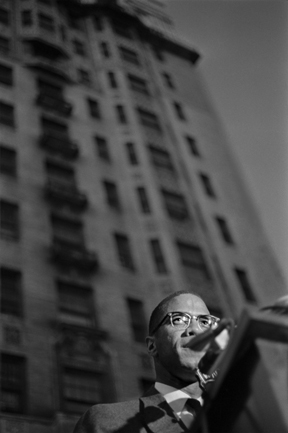
Hugh Bell was a renowned art and commercial photographer, who worked in New York City over the course of his entire professional career. Upon his death in 2012, his son-in-law, Richard Martha, was named Executor of the Estate of Hugh Bell. In 2014, a boutique archival firm, Gartenberg Media Enterprises (GME), was engaged on an exclusive basis by the Bell Estate to manage the collection of Hugh Bell’s photographs and to further the artist’s legacy.
Hugh Cecil Bell was born in 1927 in Harlem, New York City to parents from the Caribbean island of St. Lucia. As a young man he first attended City College, and then graduated in 1952 with a degree in Journalism and Cinematic Art from NYU. After NYU, Bell put his Film Degree to use and found work as a cameraman for television commercials.

Photography enables me to discover, observe [and] understand things about people and their relationships, and it allows me to capture and hold them forever… It is by photographs, rather than by talking about experiences, that I communicate.Photography is an expression of your individuality. You start with color or black and white. Then having chosen your film, the camera, the lens, the developer, the paper for the final print, you can create an almost infinite number of ways to make a photograph.I enjoy being in my darkroom. There is something in the still darkness that brings out your best creative thinking. You relive your past photography and plan your future… You experience a very special sensation holding the end product…the picture you have printed yourself.
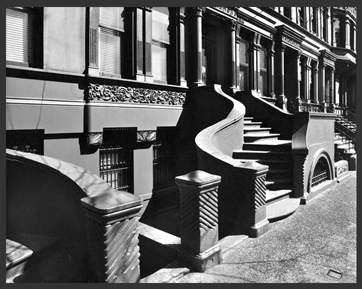
Building on his career as a young photographer in Italy, Borea began working full time in 1957 as a freelance photographer, traveling around New York City on his three-speed Dunelt bicycle. He shot photographic essays of now-demolished New York City landmarks, including the Washington Square Market and the Third Avenue El. He also photographed many other cityscapes, including Central Park, Riverside Park, and the New York City subway system. In his picture-making, he often transformed these locales into studies of abstraction. Borea also produced photographic essays from his travels around the US and abroad.
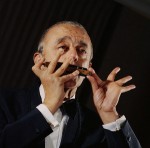
After a successful career in business, Bern Schwartz (1914–78), returned to his hobby of photography at the age of sixty. Within just four years, he established himself as a renowned portrait photographer attracting famous sitters from across the globe. These included prominent members of the British establishment of the time—actors, dancers, artists, writers, politicians and royalty—as well as international luminaries. His portraits were first exhibited to great acclaim at the Colnaghi Gallery in London in 1977. Further exhibitions followed including more recently at the National Portrait Gallery, London in 2008-09, and at the Mishkenot Sh’ananim and the Naggar School, Jerusalem in 2012. His work is represented in public and private collections worldwide.
Thirty years later, these portraits still engage the viewer. Their immediacy and often informal style are due, in part, to Schwartz’s approach. He usually captured his sitters at home or at work. And, with his wife and collaborator Ronny, he conducted extensive research before each sitting. This allowed him, instead of standing behind the camera, to engage in animated conversations with his subjects who barely noticed his click of the shutter release kept in his pocket.
“He caught us when we weren’t posing,” recalled the journalist and broadcaster, Alistair Cooke, one of Schwartz’s subjects, “which is how he captures so much life and animation. It was as if we weren’t even having our picture taken, just talking with a friend.” Schwartz recorded each sitting in his journal, excerpts from which are included in some of the labels that accompany the photographs on this website.
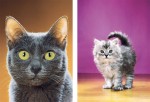
For the past 70 years, 95-year-old Walter Chandoha has made a career out of photographing cats for both editorial and commercial purposes. This year, Aperturepublished a collection of Chandoha’s colorful cat photographs in the appropriately titled Walter Chandoha: The Cat Photographer.
A self-described lover of photographing “everything and anything,” Chandoha first stumbled into cat photography after he found a stray kitten he named Loco in the snow. He took a few pictures of Loco, submitted them to various contests, and won a few prizes. But things didn’t get serious until the early 1950s when Chandoha began photographing in color. With help from his wife Maria, who was his art director, secretary, animal herder, and also the mother of their six children, he began to play around with a few different ideas, including photographing a kitten wearing a red Christmas ribbon. They submitted that image to some magazines and were thrilled when Woman’s Home Companion called to say they were going to run the image on their cover and offered an incredible payment of $500.
To read the full article:
http://www.slate.com/blogs/behold/2015/12/18/walter_chandoha_is_the_cat_photographer_photos.html


MARVIN KONER
1921–1983
http://marvinkonerarchive.com
Pam Koner, Pam@MarvinKonerArchive.com
For nearly four decades, American photojournalist Marvin Koner traveled the world capturing the people, places and personalities that shaped the latter half of the 20th century.
Born into a family of Russian intellectuals in New York City, Marvin Koner would come to see the world through the eye of his camera – observing and chronicling the ordinary and extraordinary.
Stationed in the South Pacific during World War II, Koner served as a First Lieutenant in the Army Photo Intelligence Unit where his interest in photography began. At the end of the war he returned to New York determined to make a career in photography, and enabled by the G.I. Bill, studied with Alexy Brodovitch, the renowned art director of Harper’s Bazaar Magazine.
Spearheading the use of the 35mm. camera and available light, for the next 30 years, Koner’s work appeared in leading magazines, including Life, Fortune, Look, Esquire and Collier’s. During the course of his career Koner received numerous awards from professional journals and served a number of terms as Vice-President of The American Association of Magazine Photographers.
Koner photographed many distinguished subjects, most notably Martin Luther King, Robert Frost, Margaret Mead, Robert Kennedy, Frank Lloyd Wright and Eleanor Roosevelt. Always eager to tell a story, Koner photographically retraced James Joyce’s “Ulysses” main character, Leopold Bloom’s journey through Dublin, covered the exchange of prisoners at the end of the Korean war for Collier’s Magazine, and in the early 1960’s followed the migration by boat, of an Italian family to New York. When the interest in photojournalism diminished and virtually disappeared, Koner turned from magazines to corporate photography on an international scale. His color images of industry, architecture, nature and portraiture have been published worldwide.
Koner died in 1983 at the age of 62. His work in is the permanent collection of the International Center for Photography where a one-man show of his photographs was held there in 1993, The Metropolitan Museum of Art, and the Museum of Modern Art.
By Judith Thompson
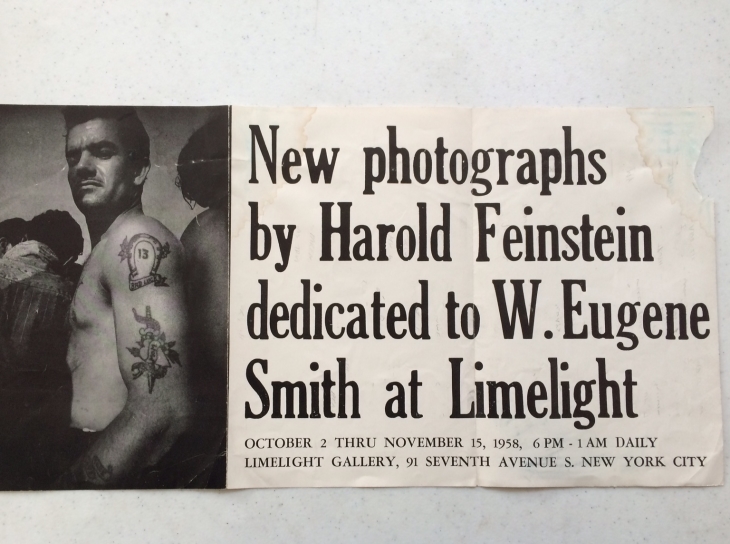
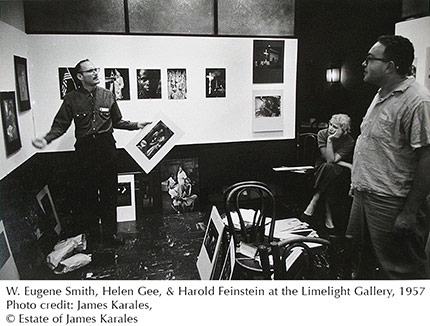
I recently discovered the poster above while going through one of the many boxes of ephemera in the studio. I knew about the show at the historic Limelight Gallery, the first of it’s kind photography gallery launched by Helen Gee. However, I hadn’t known that Harold had dedicated his show to Smith. It is just one more indication of the important friendship between the two of them. I wish I had Harold here now so that he could tell me more about his dedication. These photographs show Smith preparing for his own show at the Limelight in 1957. He asked Harold to help him edit and hang the show. For more on that, read Harold’s earlier blog: W. Eugene Smith and me at Helen Gee’s Limelight Gallery, 1957.
READ THE COMPLETE BLOG POST HERE: on http://www.haroldfeinstein.com/harold-w-eugene-smith-the-jazz-loft-and-helen-gees-limelight-gallery/
On Friday November 13th, Muna Tseng gave a talk at Paris Photo Platform on the Panel Epic Journey: Photographic Legacies. She discussed the management, preservation and upkeep of the Tseng Kwong Chi estate and archive. Photos of the talkare available on facebook, and you can watch the talk here.

Our hearts go out to those lost and hurt in Paris. They are in our thoughts.