APAG - American Photography Archives Group
  • Home
  • About
    • APAG Board
  • Membership
    • Members Only
  • News
  • Resources
  • Members Gallery
  • Conference
  • Education
  • Contact

AIPAD at the Armory – April, 2016

Posted on July 31, 2016 by APAG in News

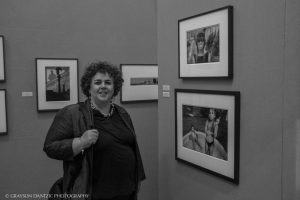
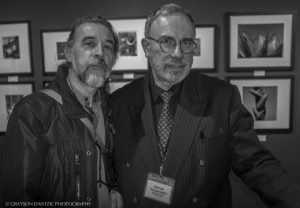
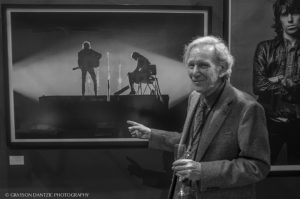
AIPAD.Engel        2016_04_13_AIPAD_GraysonDantzicPhoto-12        2016_04_13_AIPAD_GraysonDantzicPhoto-14

I attended last night’s AIPAD opening and was pleased to see many APAG members including the APAG Board, Grayson Dantzic, Julie Grahame, and Ernest Londa, Advisors, Howard Greenberg and Andrew Smith. Members, Valdir Cruz, Diana Edkins, James Garfinkel, Daniel Kramer, Peter Kunhardt Jr., Scotia Macrae, Patrick Montgomery, Marvin Newman, Emma Winter, and Kore Yoors, Past speakers Denise Bethel, Gail Buckland, Peter Mustardo, Jeff Rosenheim and others,

Also, despite the fire that recently destroyed much of the archive of Linda Troeller, it was great to see both Linda and Lothar Troeller. A gofundme.com account has been started to help. Also, Peter Mustardo of www.thebetterimage.com offered to talk wtih her to see if he can be of any help. Many thanks to Peter!  – by Mary Engel

Lucien Aigner’s archive acquired by Addison Gallery/Phillips Academy and Beinecke/Yale

Posted on July 31, 2016 by APAG in News

andover-2

Lucien Aigner, Leniel Hooker, Max Manning, Jim Brown, and manager Raleigh “Biz” Mackey, Newark Eagles, 1939.

NEW HAVEN, CONN.- The Addison Gallery of American Art at Phillips Academy, Andover, the Yale University Art Gallery, and Yale’s Beinecke Rare Book & Manuscript Library have acquired the Lucien Aigner Collection, an extraordinary archive of photographs, negatives, recordings, film, books, magazine clippings, letters, and journalistic writings.

A pioneer of 1930s photojournalism, Lucien Aigner (1901–1999) belonged to the generation of photographers that included Robert Capa, Henri Cartier-Bresson, Alfred Eisenstaedt, and Erich Salomon. Embracing the introduction of 35mm film and fast, small, lightweight cameras, these artists changed the face of photography, making candid images that captured contemporary life with powerful immediacy.
Born in Hungary in 1901, Aigner began his career as a reporter, then became a photojournalist for Az Est, a Budapest daily newspaper. At the age of 25, he moved to Paris to work for James Abbe, an American freelance photojournalist. Though this job was short-lived, Aigner remained in Paris and established himself as an enterprising photojournalist—and early practitioner of the Leica camera—whose pictures of world leaders and events, as well as the city and its people, appeared in prominent photojournals such as Vu, Picture Post, and LIFE. In 1939, before the invasion of France, he immigrated to the United States, where his work appeared in such publications as the New York Times, the Christian Science Monitor, Look, Coronet, and Pageant. He became an announcer and eventually a producer and director at the Voice of America in the late 1940s. During the McCarthy era in the early 1950s, he was forced to leave his job. For the next 20 years or so he operated a portrait studio in Great Barrington, Massachusetts. In 1970, Aigner rediscovered a suitcase that—having survived WWII occupation—contained approximately 50,000 of his 1930s negatives. He had not opened it since 1950 when his brother, leather goods designer Etienne Aigner, emigrated from Paris and returned it to him. Several years later, the photographer closed his portrait studio to focus on the cataloguing and indexing of his collection of over 100,000 negatives. Following his death in 1999, Aigner’s family continued to catalogue, research, and care for this vast collection.

Consisting of tens of thousands of negatives and thousands of prints and contact sheets, this rare and comprehensive collection is made all the more unique by Aigner’s extensive writings that accompany virtually every image or series of images and explain the circumstances under which they were shot, and often the current events that surrounded the photo shoot. Considering himself as much a journalist as a photographer, Aigner paired text and pictures to vividly describe a range of themes, from European cafés to American prisons; from Bastille Day celebrations in Paris to amusement rides in Coney Island; from rehearsals at the Paris Opera Ballet to street life in Harlem. Documenting major European and American political and cultural events, Aigner’s archive includes portraits of world leaders and celebrities including Louis Armstrong, Josephine Baker, Winston Churchill, Albert Einstein, Adolf Hitler, Benito Mussolini, Sara Delano Roosevelt, and Haile Selassie, among numerous others. A master at timing, Aigner’s candid portraits reflect his desire to reveal the essential vulnerability of prominent figures.

For more info:

http://artdaily.com/news/86357/Photojournalist-Lucien-Aigner-s-archive-acquired-by-Yale-University–Addison-Gallery#.V54lk7grKUl

Jack Mitchell photographs acquired by Smithsonian National Museum of African American History and Culture

Posted on June 15, 2016 by APAG in News

Belafonte_Harry_1970_color    Houston_Whitney_1982_5842-5842         Price_Leontyne_5311-2340  

Harry Belafonte                 Whitney Houston                       Leontyne Price

Smithsonian National Museum of African American History and Culture Acquisition of Jack Mitchell Photographs

Twenty-five Jack Mitchell photographs of important African American artists and performers are now a part of the permanent collection of the new Smithsonian National Museum of African American History and Culture.

The acquisition includes lifetime vintage silver gelatin and color photographs made by Jack Mitchell over a career spanning five decades. Mitchell died in 2013 at age 88. His first ever cover photograph for a major magazine was of Haitian dancers for the May 1951 issue of Color Magazine.

The subjects include singer-songwriter Harry Belafonte, the Katherine Dunham Dance Company, actress Gloria Foster, singer Whitney Houston (in her first photo session with a professional photographer), dance company founders Bill T. Jones and Arnie Zane, dancer/actress Carmen de Lavallade, writers Audre Lorde and Toni Morrison, singer Odetta, actor Melvin Van Peebles, opera singer Leontyne Price, hip hop group Public Enemy, designer Willi Smith, La MaMa theatre founder Ellen Stewart, singer Donna Summer, actress Cicely Tyson, actor Ben Vereen, and dancer George White.

The Smithsonian National Museum of African American History and Culture opens September 24, 2016, on the National Mall in Washington, D.C., and will reflect the richness and diversity of the African American experience. Jack Mitchell’s photographs are also in the permanent collections of the Smithsonian Archives of American Art, the Smithsonian National Portrait Gallery, the Andy Warhol Museum, the John Lennon Museum, Harvard University, the Metropolitan Opera Portrait Gallery, and many others.

View all 25 photographs on the Jack Mitchell Archives website, here:

http://www.jackmitchell.com/announcements.php

Craig B. Highberger

Executive Director, Jack Mitchell Archives

http://www.jackmitchell.com

Harold Feinstein and Getty

Posted on May 26, 2016 by APAG in News


09 May 2016

Getting it together with Getty Images

Harold's 1957 Cruising on Saturday night, Times Square in Getty Images book The Year in Focus, 2015.
Harold’s 1957 Cruising on Saturday night, Times Square in Getty Images book The Year in Focus, 2015.
Getty Images Year in Focus, 2015

It’s been a real pleasure getting to know Bob Ahern, Director of Archival Imagery atGetty Images. I was happy to see his recent contribution toThe Eye of Photography, announcing the distribution partnership between Getty andConde Nast. We met over a glass of wine during my recent trip to NYC for the AIPAD (The Association of Photography Art Dealers) show. I was delivering a print for the annual Chris Hondros Fund auction (Chris was a Pulitzer nominated Getty photojournalist who died in a government forces mortar attack in Libya in 2011). Bob was delivering Getty’s Year in Focus book for 2015. As he flipped it open to the two page spread featuring Harold’s Cruising’ on Saturday night (1957), he quipped: “Not bad placement–between Bert Stern and Conde Nast!”

Julie Graham and Bob Ahern at the APAG seminar 2015 © Harris Fogel.
APAG vice-president and curator, Julie Grahame with Getty Images Director of Archival Images, Bob Ahern at the APAG seminar 2015 © Harris Fogel.

I first met Bob last year at the annual APAG (American Photo Archive Group) seminar and he approached me about bringing Harold’s work into the Getty Images Archive. I agreed. For the past 3 months, studio manager, John Benford, has been fast at work key wording and prepping our scanned negs for submission to Getty’s database. It’s a long, slow process, but the folks at Getty have been consistently helpful in guiding us through the process. Two hundred down another thousand to go!

Harold's page on Getty Images
Harold’s page on Getty Images

Particular kudos to Bob who oversees the entire archival catalogue and yet still seems to find time to return calls and emails within a day! I’m impressed. While we will continue to license images directly through the studio, we are excited about the amazing reach that Getty Images has and expect to see the money rolling in before too long! (Said with a good degree of hope and humor!) Thanks to the gang at Getty for making it a reasonably seamless process so far!


FIND OUT MORE

  • The Harold Feinstein Photography Trust pictures
  • Getty Images, 80 million images dating back to the beginning of photography
  • The Chris Hondros Fund
  • The American Photography Archive Group
  • Hidden Treasure: The American Photo Archive Group
  • The American Photo Archive Group
  • My visit to AIPAD

Chester Higgins Jr. profile in American Photographer AI-AP – April 12, 2016

Posted on May 1, 2016 by APAG in News

ChesterHiggins2        ChesterHiggins3

ChesterHiggins5         ChesterHiggins4

Photographer Profile – Chester Higgins, Jr.: “I believe the spirit of things exists in everything”

By David Schonauer Tuesday April 12, 2016

When something ceases to live, what is left behind?
It’s a philosophical question. It’s a religious question. And for Chester Higgins, Jr., it’s a photographic question.

Higgins has been an esteemed figure in the New York photography world for decades. A staff photographer for the New York Times from 1974 to 2014, he has been called one of the premier African American photographers of his generation, though the description is perhaps too limiting. Among his six books are Black Woman, Some Time Ago: A Historical Portrait of Black America (1850–1950), and Feeling the Spirit: Searching the World for the People of Africa.

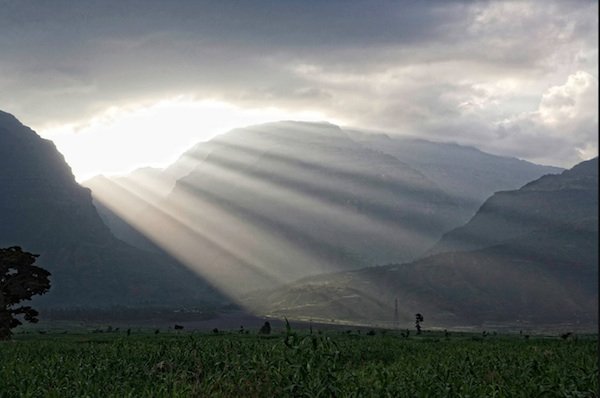
His most recent book, Ancient Nubia: African Kingdoms on the Nile, is the result of a long-time interest in that region of the world — he has traveled to Africa every year since 1971 — and his next one, which he hopes to complete this year, is a visual narrative about the birth and evolution of spirituality and pre-biblical faith along the Blue Nile in Ethiopia and Egypt. It is called Before Genesis.

At age 70, Higgins, as inquisitive as ever, has been working on other projects as well, though he says he’s been spending too much time at the doctor recently. “The good news is that whatever he’s doing is working,” he adds. One of those projects has involved investigating spirituality in a new way — by photographing leaves.

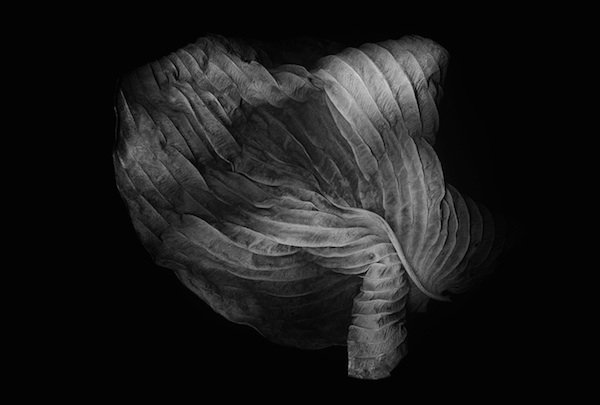
For the past several years, Higgins has been collecting leaves that have fallen from trees in the autumn and begun to decay. His black-and-white photographs of them are exquisitely lit and abstracted in Photoshop to the point at which the leaves become nearly unidentifiable objects. They capture something essential, what Higgins calls “the spirit of the thing.”

“I believe the spirit of things exists in everything, including plant life and animal life,” he says. “So I started challenging myself to see if I could translate this spirit into an image.”

His goal, he says, is to see “the macro in the micro,” the universe in the withered residue of foliage.

His ideas are influenced by the years he has spent in Africa, surrounded by the artifacts of life and faith left by cultures that have long since disappeared.

“My love of Egyptology has stretched me and made me realize that reality is more like theater,” he says. “We are acting out a part, and our egos make us think that we are the central role in the drama, when in fact we are just going through a ceremony that comes out of the past.”

Recently, the Studio Museum in Harlem asked Higgins to contribute work to its annual “Harlem Postcards” project, in which artists interpret the neighborhood through various mediums. “In previous days, I would have gone up to Harlem and shot a representational photograph of the place,” says Higgins. “But I’ve become consumed with this other project, so instead I walked around Harlem last year picking up leaves that were dying and falling.”

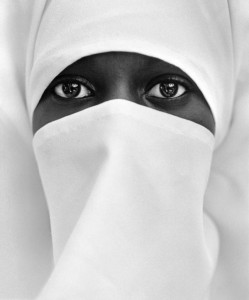
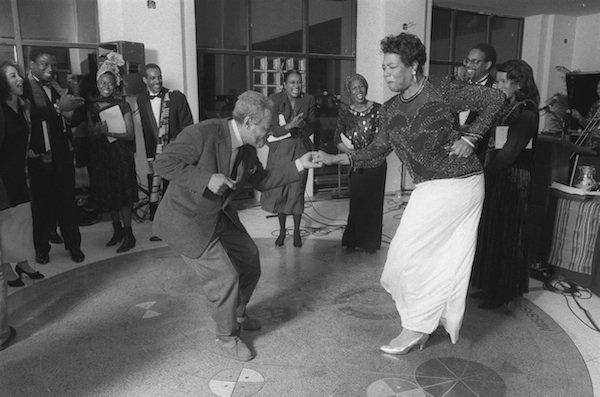
The image he ended up creating, called “Harlem Spirt,” is on view through June 26. Higgins sees a connection between it and the other images he has made throughout his career as a newspaper photographer and artist, among them a striking portrait of a Muslim woman in New York and a photo of Maya Angelou dancing with poet Amiri Baraka over the ashes of Langston Hughes in the New York Public Library’s Schomburg Center for Research in Black Culture.

“What has always driven my photography is the search for the spirit of things,” he says.

The Camera Never Lies About the Photographer

Higgins grew up in rural Alabama — in the town of New Brockton — and, he says, became a photographer by accident. If you believe in accidents.

He attended the Tuskegee Institute (now Tuskegee University), where he saw a picture by the school’s official photographer, P. H. Polk, that made a deep impression on him.

“He had photographed black country people, farmers in the 1930s. They were very dignified portraits. Today you wouldn’t think that was significant. But at that time, in Alabama, the only photographs of black people you saw featured convicted felons and prostitutes,” he says. “Seeing Polk’s pictures for the first time, I realized how different they were from every other photograph I’d ever seen. And I liked that.”

Higgins studied with Polk, but never considered photojournalism as a career until he saw how powerfully persuasive it could be when used wrongly.

“When I was at Tuskegee, the civil rights movement was in full swing, and we students would sometimes go to Montgomery to protest.” he says. “Then one day I looked at a newspaper that had pictures of us, these young citizens petitioning our country. Except that’s not how the photographer chose to show us. He made us look like thugs, potential rapists and arsonists causing trouble.”

He came to know an important truth about photography. “I learned that the camera never lies about the photographer,” he says. “I had a choice: I could wail against the racism of the pictures or I could go and create photographs that would tell a contrary story.”

After graduating in 1970 Higgins went to New York in search of a teacher.

Discoveries From the Ancients

“In those days there were really no photography schools,” he says. “I went to all the newsstands and looked at the magazines that used pictures well, and I called up each photo editor and said, ‘I’m a student from Alabama and I want to be a photographer, but there’s no place I can learn. I am not looking for a job. I’m looking for someone to show me how to be a better photographer.’”

He found that person at Look magazine, the bi-weekly competitor of Life magazine. Its director of photography at the time, Arthur Rothstein, had created iconic photos of depression-era America as part of the Farm Security Administration, and he saw promise in Higgins. He mentored him and introduced him to prominent curators and photographers, including John Szarkowski at the Museum of Modern Art and Cornell Capa, who a few years later would found the International Center of Photography.

Higgins made his first trip to Ethiopia in 1973, after learning that that African heads of state were gathering for an Organization of African Unity meeting in Addis Ababa. Thereafter he returned annually. “I used my vacation time to travel to Africa each year,” he says.

He didn’t go to get away, however.

“When I travel to Ethiopia or Africa, I’m not in search of something exotic, I’m in search of reflections of myself. In Ethiopia, I’m no longer in a society where I am a minority. I am the majority,” he said in an interview in the Times in 2015.

In the 1980s Higgins began photographing mummies in the Cairo Museum and became absorbed by the culture of ancient Egypt and the religion that it was built around — one, he notes, that is based in nature.

“Reading about this complex belief, in which deities represented aspects of nature, brought me back to the celebration of the seasons I had witnessed in my childhood,” he said in a recent interview. “The ancients honored the spirit in all things, a philosophy I apply to my image-making today.”

Higgins’s work in Africa is, he says, a search: He looks for what he calls “evidence of humanity’s spiritual legacy.” In Africa, he finds that evidence in ruins and enduring ceremonies. In Harlem, he found it in a leaf.

http://www.ai-ap.com/publications/article/17279/photographer-profile-chester-higgins-jr-i-be.html

The Gordon Parks Foundation 10th Anniversary Awards Dinner and Auction

Posted on April 26, 2016 by APAG in News


http://www.gordonparksfoundation.org/news-and-events/gala/the-gordon-parks-foundation-10th-anniversary-awards-dinner-and-auction

Jurgen Schadeberg

Posted on April 26, 2016 by APAG in Member Profile
Air Raid Shelter, Berlin, 1942
Hamberg Handstand, 1948
Miriam Makeba, 1955

Nelson Mandela in his law office, 1958
Nelson Mandela, Treason Trial, 1958
Mandela’s return to his cell on Robben Island, 1994

THE ARCHIVE & PRINT COLLECTION OF JURGEN SCHADEBERG

65 YEARS OF PHOTOGRAPHY BY JURGEN SCHADEBERG

schadebe@iafrica.com  – www.jurgenschadeberg.com

200,000.00 negatives 1942 – 2014 – 4,000 plus silver prints, many vintage, all hand printed by Jurgen Schadeberg, 500 plus colour giclee archival prints

SOUTH AFRICA – 1951 – 2009

500 plus archival black and white silver prints and colour giclee prints by Jurgen Schadeberg which cover six decades of South African photography.

10% are vintage prints and the balance are late prints.

A Retrospective of films by Jurgen & Claudia Schadeberg , a one hour Arte documentary about Jurgen Schadeberg and accompanying books and catalogues

——————————————————————————————————–

The above section of images covers key social, cultural and political events and personalities in the early struggle for freedom in the fifties and are 60 silver prints of the black and white fifties. They are all silver gelatin prints and the average paper sizes are 40 x 50 and 50 x 60 cms. All these images were taken during the fifties in South Africa – many images come from the book “The Black and White Fifties”. This set of images includes prints of Nelson Mandela in the fifties.

The 1952 Defiance Campaign, 25 silver prints in paper sizes from 30 x 40 (unframed)

The Rise and Fall of Sophiatown – fifties – 25 framed silver prints of Sophiatown in its heyday, its forced removal and demolition to give way to a white suburb called Triomf.

The San of the Kalahari 1959 – a set of 12 framed silver prints of the San Dance of Exorcism


The story of jazz, swing and blues over six decades – 60 framed silver prints –Portraits of the most talented and influential jazz and blues singers and musicians many of whom have been sadly neglected an forgotten.

The story of Robben Island, the prison, the island and former inmates, including Nelson Mandela and Walter Sisulu – 15 framed silver prints.

Kliptown today – 2003 the Soweto suburb where the historic Freedom Charter was formed which was the basis for South Africa’s new constitution. We see how the Kliptonians live and survive today – 40 framed silver prints & 40 unframed silver prints

Voices from the Land – 2007 – a study of farm conditions in South Africa today with stories from farmers and farmworkers – 128 framed and crated silver prints.

Tales from Jozi – 2007 – the story, in colour, of life today in Johannesburg showing the diverse lives and lifestyles of a city in transition- 92 archival framed colour giclee prints in crates.

On the Beach – 1995 – a range of framed black and white and colour images of happy beach scenes from Camps Bay to the Oyster Box – 20 giclee colour prints – paper sizes range from 80 x 80 cms to 40 x 40 cms.

All the photos are digitised and all the prints have been hand printed and signed by Jurgen Schadeberg.

————————————————————————————————————-

GREAT BRITAIN – 1964 – 1984

GERMANY – 1942 – 2012

GLASGOW, GREAT BRITAIN 1968

FRANCE – 1984-1985 & 2007 – 2010

SPAIN – 1968-1971 & 2012-2013


Susan May Tell’s photos in new book, a group exhibition and an interview in an Adorama series.

Posted on April 17, 2016 by APAG in News
I am thrilled that two of my photographs are in fossils of light + time, a limited edition book, curated and exquisitely designed by Elizabeth Avedon — in collaboration with, and published by, the Detroit Center for Contemporary Photography. The photograph above, Man Through Van, opens the book.

The book’s title is from a beautiful and seductive quote by Daido Moriyama, “If you were to ask me to define a photograph in a few words, I would say it is “a fossil of light and time.”

The Limited Edition of 250 has Sold Out. Many thanks to DCCP’s Kyohei Abe and Kottie Gaydos for the superb printing. A complete list of the artists and more information is available here.


I am excited Adorama chose to feature my work on their widely read series about photographers and titled it: Meet A Pro: Susan May Tell, Poet with a Camera. The wide-ranging interview offered a special opportunity to discuss the similarities between poetry (especially that of William Carlos Williams, Wallace Stevens and Stanley Kunitz) and my photography. That relationship was highlighted during my recent residency at The MacDowell Colony when my photographs inspired poets to write about them. That’s probably the highest form of praise there is.

Click here to read the interview and see more photographs.


I was honored that a selection of my photographs taken in the Middle-East (Egypt, Eritrea, Iraq, Israel and Kuwait) were featured in I/Thou, an ambitious group exhibition at New York University’s Stovall Gallery. Curated by Pamela Jean Tinnen, NYU’s Curator and Exhibition Coordinator of Kimmel Galleries, the exhibition reflected on concurrent themes in social justice. I/Thou ran from September 9th to October 25th and a highlight was an Evening with the Artists and Curator on October 9th.


I feel incredibly fortunate to have spent the month of February in residence at the Virginia Center for the Creative Arts. My world in New York City is very photo-centric. In a poem of William Carlos Williams he wrote that he “discovered that most of the beauties of travel are due to the strange hours we keep to see them.” After being at the VCCA, I can say that many of the best parts of an artist residency are due to the talented artists of various disciplines we meet there.


Thank you for your interest!

Susan May Tell
susanmaytell.com

Jack Mitchell

Posted on April 8, 2016 by APAG in Member Profile
Merce Cunningham Company, 1975
Arnold Schwartzenegger, 1976
James Levine, 1982

Jane Forth, 1971
John Lennon and Yoko Ono, 1980
Leontyne Price, 1978

Jack Mitchell

Native Floridian Jack Mitchell (1925-2013) was an avid photographer whose work was published in Florida newspapers and national magazines before he was out of high school. Jack Mitchell moved to New York City after serving in WWII and spent the next five decades there. His photographs have appeared worldwide in newspapers and magazines including Time, Life, Newsweek, Rolling Stone, Vanity Fair and Vogue, and Mitchell photographed more than 160 covers for Dance magazine. His work chronicles the greatest dancers, actors, writers, artists and musicians of the late 20th century.

Craig B. Highberger, Executive Director Jack Mitchell Archives

Email: craig.highberger@gmail.com Website: www.jackmitchell.com

Larry Racioppo

Posted on April 5, 2016 by APAG in Member Profile
1. Corridor, Ellis Island 1998
2. Hamlet’s Father, Halloween 1982
3. Auto Wreckers and bayonne Bridge 1993

4. Lobby, House of Prayer for All People 1999
5. Demolition of the Thunderbolt 2000
6. Quentzel Plumbing Company 2008.

Larry Racioppo  141 Beach 129th Street   Rockaway, NY 11694

larryracioppo.com

Larry Racioppo

b. 1947

Home Page: larryracioppo.com

Archive Contact: larryracioppo@gmail.com


LARRY RACIOPPO was born and raised in South Brooklyn. After two years as a VISTA volunteer in California, he returned home in December, 1970, intending to become a photographer. While working a series of jobs—telephone repairman, taxi cab driver, waiter and bartender, and photographer’s assistant—he completed his undergraduate work at Fordham University and earned a master’s degree at Brooklyn College.

All the while, Racioppo was photographing his neighborhood, working in black-and-white 35mm and later in 120mm film. He had his first solo exhibition in 1977 at Brooklyn’s f-stop gallery, and in 1980 Scribner’s published his first book of photographs, Halloween.

In 1989 Racioppo became the official photographer for New York City’s Department of Housing Preservation and Development, hired to document the city’s re- building of its distressed neighborhoods, from Bedford Stuyvesant to Harlem to the South Bronx.

When he received a Guggenheim Fellowship in Photography in 1997, Racioppo took a leave from HPD to create a series of panoramic urban landscapes. He returned to HPD to coordinate LANDSCAPES OF HOPE an exhibit at the Museum of the City of New York documenting the agency’s work. While continuing to photograph for HPD until 2011, Racioppo had solo exhibits of two in-depth personal projects: FORGOTTEN GATEWAY: The Abandoned Buildings of Ellis Island at the National Building Museum, and THE WORD ON THE STREET at the Museum of Biblical Art.

Racioppo has received grants from the New York State Council on the Arts, the Queens Council on the Arts, and the Graham Foundation. In 2006 he received a National Endowment for the Arts Chairman’s Extraordinary Action Grant for his exhibit “The Word on the Street” at the Museum of Biblical Art in New York. Racioppo’s work is in the collections of the Museum of the City of New York, The Brooklyn Museum, the Brooklyn Public Library, El Museo del Barrio, and the National September 11 Memorial & Museum.

  • «
  • ‹
  • 8
  • 9
  • 10
  • 11
  • 12
  • ›
  • »

APAG

  • Home
  • About
    • APAG Board
  • Membership
    • Members Only
  • News
  • Resources
  • Members Gallery
  • Conference
  • Education
  • Contact

Contact APAG

Contact APAG for membership, information, or with questions:

Visit our Contact Page »

Follow us on Facebook »

All photos on this website are protected by copyright of the individual photographers and archives whose photographs are represented. All rights reserved, and photos are not allowed to be used for any purpose without permission. Please write to the archives or photographers directly for permission requests.

(*) ©2026 APAG – American Photography Archives Group | Site by KPFdigital | Log in