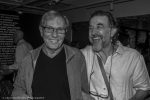
A Conversation With Fred Lyon, San Francisco Photographer Since The 1940s by Lisa Amand

Growing up in Burlingame, he attended Art Center College before becoming a Navy pilot then Navy photographer. Sent to the White House to shoot Franklin Delano Roosevelt, he quickly learned how to get important people to sit still for a photo shoot, moving on to document more presidents, movie stars, high-fashion models, musicians, authors and painters.
We caught up with him at his Cow Hollow studio and home on Lyon Street (naturally), jauntily dressed, loquacious, self-effacing and irreverent.
Approaching his 92nd birthday this month, he’s still busy scanning, printing and selling beautiful pictures.
He’s also pleased with his current exhibition at the Leica Store at 463 Bush St. (on view through October 22nd) and renewed interest in his latest book.

Q: What has motivated you for the past seven decades?
Lyon: I’ve always had a ravenous camera and my camera would always take me out on these excursions.
Q: Why have you focused on San Francisco?
Lyon: It was right after World War II and everything was happening here. Again, I just backed into that good era where everybody was optimistic… At the end of every month when I was facing the rent, I would try to dream up story ideas for magazines. And I can remember the magazine picture editors had never been to San Francisco and they’d say, ‘Well, what’ve you got out there?’ And I would say, ‘That’s easy. We’ve got steep hills. A couple of bridges that won’t quit. We’ve got cable cars. We have Chinatown. We have fog. And we have Herb Caen.’

Q: What does it take to be a good photographer and who do you admire?
Lyon: A lot of European and Hungarian photographers. Atget, Andre Kertesz, Cartier-Bresson. The greatest attribute that any photographer can have is insatiable curiosity.
One of the very first Life Magazine staff photographers was Alfred Eisenstaedt. When I would meet him in the Time-Life Building, he would attack everybody he met because he wanted to know everything that was in their head. He was the ideal photojournalist because he was consumed with curiosity. And it was global… Eisy had no restraint at all… He had nothing but good instincts.

Q: What’s your attachment to the wine country?
Lyon: I had a very small vineyard in the Napa Valley, and I grew very good grapes. They never reaped the prices they deserved but I grew because I wanted to grow them. I bought a seven-acre parcel of vineyard to escape the San Francisco fog and I built a house there. But before I even built the house, I was so in love with wine grapes and the vines and the whole process that I was addicted to growing wine grapes.
Q: Do you still take photographs, and if so, what kind of camera do you use?
Lyon: Not very much any more. I’m having trouble walking these days so that’s limiting. An occasional photograph, but it’s hard to maneuver.
I use a digital camera. I haven’t used film since about 2006. A lot of people are shocked at that, they think I should still be using film. My god, I gave it its chance. And I did everything. Now digital allows us to do things that we couldn’t even dream of, even five years ago. It moves so fast, it’s impossible to keep up.
Q: Is there one photo that you’re most proud of?
Lyon: Probably that one of the couple walking in the fog. It would be my best known.

In those early days, I lived in Sausalito. I had a new bride. We’d been invited upstairs for a cocktail. But earlier in the day, I’d spoken with an editor of a story I was doing on San Francisco and he said, ‘Fred, we’re trying to close this story but we need a fog picture.’ I said, ‘You cannot queue the fog here, we haven’t had a foggy night.’
He said, ‘We‘re holding a space for it, but you better get it soon and you better get it good.’
My wife and I went upstairs to our landlord and he was just about to pour the drink and I looked out the window and I saw the fog snaking in through the Golden Gate.
I said, ‘Don’t pour, we got to take a picture.’ My landlord and my wife said, ‘What do you mean? We’re dying of thirst, we’re ready to drink.’
I said, ‘I promise, we’ll go to the nearest bar if I just get this fog picture. But we’ve got to go right now.’
We went out to where Sutro Baths was…We parked the car there. We got out and it was wonderful, thick fog. That’s an idyllic picture of a couple, very romantic. It’s my landlord and my wife. And what they’re saying: ‘Fred, for Christ’s sake take the goddamn picture, we’re dying of thirst and we’re freezing.’
I said what I learned to say in the White House, “One more please, Mr. President. Let me get a couple more exposures for insurance.”
Q: Are you going to write a memoir?
Lyon: Oh God, no. Why frighten everybody.

 In Photographing Ina, Philip Trager (born 1935), renowned for his black-and-white images, embraces color for the first time. His images are as much about the act of photographing, perception, color and light, as they are about his subject, his wife Ina, whose presence is a constant and unifying motif.
 The luminous and compelling photographs in New York in the 1970scapture the essence of a city in a way best described as “place portraiture.” Trager’s images present the architecture of Manhattan with time-defiant clarity and beauty. Although Trager selected his subjects for aesthetic and visual reasons-rather than from an historical or documentary point of view-with the passage of time his distinctly imaginative photographs have also acquired value as historical documents. The negatives for the images in this book, only recently rediscovered, had originally been archived for printing but Trager began other projects before any prints were made. The photographs in New York in the 1970s were taken at the same time as Trager’s timeless Philip Trager: New York, published by Wesleyan University Press in 1980, in which the photographer depicts the city “as a solitary figure, always aware of the ‘enveloping sky.'” New York in the 1970s reveals Trager’s more concentrated attention to the interaction between the city’s architecture and the dynamics of the street.