APAG - American Photography Archives Group
  • Home
  • About
    • APAG Board
  • Membership
    • Members Only
  • News
  • Resources
  • Members Gallery
  • Conference
  • Activities
  • Contact

Harold Feinstein and Getty

Posted on May 26, 2016 by APAG in News


09 May 2016

Getting it together with Getty Images

Harold's 1957 Cruising on Saturday night, Times Square in Getty Images book The Year in Focus, 2015.
Harold’s 1957 Cruising on Saturday night, Times Square in Getty Images book The Year in Focus, 2015.
Getty Images Year in Focus, 2015

It’s been a real pleasure getting to know Bob Ahern, Director of Archival Imagery atGetty Images. I was happy to see his recent contribution toThe Eye of Photography, announcing the distribution partnership between Getty andConde Nast. We met over a glass of wine during my recent trip to NYC for the AIPAD (The Association of Photography Art Dealers) show. I was delivering a print for the annual Chris Hondros Fund auction (Chris was a Pulitzer nominated Getty photojournalist who died in a government forces mortar attack in Libya in 2011). Bob was delivering Getty’s Year in Focus book for 2015. As he flipped it open to the two page spread featuring Harold’s Cruising’ on Saturday night (1957), he quipped: “Not bad placement–between Bert Stern and Conde Nast!”

Julie Graham and Bob Ahern at the APAG seminar 2015 © Harris Fogel.
APAG vice-president and curator, Julie Grahame with Getty Images Director of Archival Images, Bob Ahern at the APAG seminar 2015 © Harris Fogel.

I first met Bob last year at the annual APAG (American Photo Archive Group) seminar and he approached me about bringing Harold’s work into the Getty Images Archive. I agreed. For the past 3 months, studio manager, John Benford, has been fast at work key wording and prepping our scanned negs for submission to Getty’s database. It’s a long, slow process, but the folks at Getty have been consistently helpful in guiding us through the process. Two hundred down another thousand to go!

Harold's page on Getty Images
Harold’s page on Getty Images

Particular kudos to Bob who oversees the entire archival catalogue and yet still seems to find time to return calls and emails within a day! I’m impressed. While we will continue to license images directly through the studio, we are excited about the amazing reach that Getty Images has and expect to see the money rolling in before too long! (Said with a good degree of hope and humor!) Thanks to the gang at Getty for making it a reasonably seamless process so far!
FIND OUT MORE

  • The Harold Feinstein Photography Trust pictures
  • Getty Images, 80 million images dating back to the beginning of photography
  • The Chris Hondros Fund
  • The American Photography Archive Group
  • Hidden Treasure: The American Photo Archive Group
  • The American Photo Archive Group
  • My visit to AIPAD

Chester Higgins Jr. profile in American Photographer AI-AP – April 12, 2016

Posted on May 1, 2016 by APAG in News

ChesterHiggins2        ChesterHiggins3

ChesterHiggins5         ChesterHiggins4

Photographer Profile – Chester Higgins, Jr.: “I believe the spirit of things exists in everything”

By David Schonauer Tuesday April 12, 2016

When something ceases to live, what is left behind?
It’s a philosophical question. It’s a religious question. And for Chester Higgins, Jr., it’s a photographic question.

Higgins has been an esteemed figure in the New York photography world for decades. A staff photographer for the New York Times from 1974 to 2014, he has been called one of the premier African American photographers of his generation, though the description is perhaps too limiting. Among his six books are Black Woman, Some Time Ago: A Historical Portrait of Black America (1850–1950), and Feeling the Spirit: Searching the World for the People of Africa.

His most recent book, Ancient Nubia: African Kingdoms on the Nile, is the result of a long-time interest in that region of the world — he has traveled to Africa every year since 1971 — and his next one, which he hopes to complete this year, is a visual narrative about the birth and evolution of spirituality and pre-biblical faith along the Blue Nile in Ethiopia and Egypt. It is called Before Genesis.

At age 70, Higgins, as inquisitive as ever, has been working on other projects as well, though he says he’s been spending too much time at the doctor recently. “The good news is that whatever he’s doing is working,” he adds. One of those projects has involved investigating spirituality in a new way — by photographing leaves.

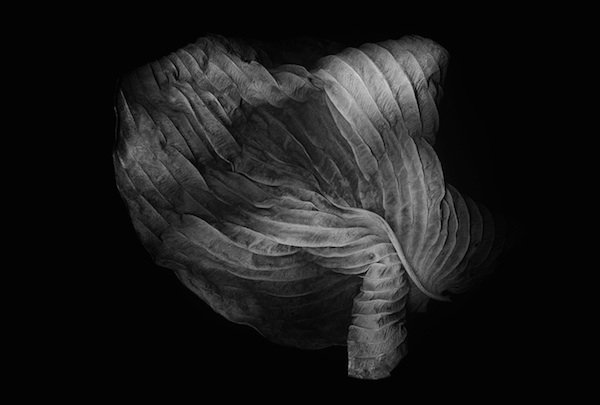
For the past several years, Higgins has been collecting leaves that have fallen from trees in the autumn and begun to decay. His black-and-white photographs of them are exquisitely lit and abstracted in Photoshop to the point at which the leaves become nearly unidentifiable objects. They capture something essential, what Higgins calls “the spirit of the thing.”

“I believe the spirit of things exists in everything, including plant life and animal life,” he says. “So I started challenging myself to see if I could translate this spirit into an image.”

His goal, he says, is to see “the macro in the micro,” the universe in the withered residue of foliage.

His ideas are influenced by the years he has spent in Africa, surrounded by the artifacts of life and faith left by cultures that have long since disappeared.

“My love of Egyptology has stretched me and made me realize that reality is more like theater,” he says. “We are acting out a part, and our egos make us think that we are the central role in the drama, when in fact we are just going through a ceremony that comes out of the past.”

Recently, the Studio Museum in Harlem asked Higgins to contribute work to its annual “Harlem Postcards” project, in which artists interpret the neighborhood through various mediums. “In previous days, I would have gone up to Harlem and shot a representational photograph of the place,” says Higgins. “But I’ve become consumed with this other project, so instead I walked around Harlem last year picking up leaves that were dying and falling.”

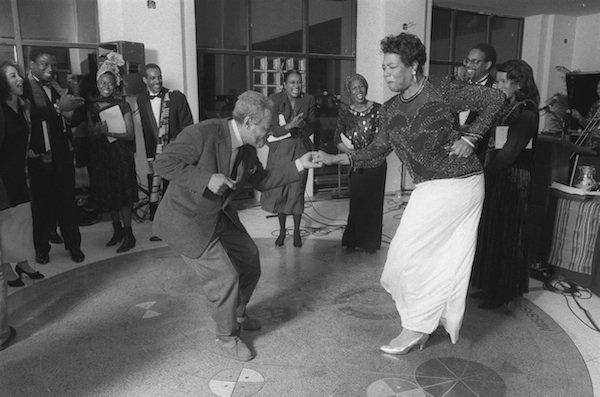
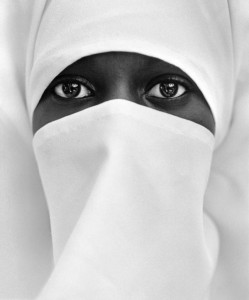
The image he ended up creating, called “Harlem Spirt,” is on view through June 26. Higgins sees a connection between it and the other images he has made throughout his career as a newspaper photographer and artist, among them a striking portrait of a Muslim woman in New York and a photo of Maya Angelou dancing with poet Amiri Baraka over the ashes of Langston Hughes in the New York Public Library’s Schomburg Center for Research in Black Culture.

“What has always driven my photography is the search for the spirit of things,” he says.

The Camera Never Lies About the Photographer

Higgins grew up in rural Alabama — in the town of New Brockton — and, he says, became a photographer by accident. If you believe in accidents.

He attended the Tuskegee Institute (now Tuskegee University), where he saw a picture by the school’s official photographer, P. H. Polk, that made a deep impression on him.

“He had photographed black country people, farmers in the 1930s. They were very dignified portraits. Today you wouldn’t think that was significant. But at that time, in Alabama, the only photographs of black people you saw featured convicted felons and prostitutes,” he says. “Seeing Polk’s pictures for the first time, I realized how different they were from every other photograph I’d ever seen. And I liked that.”

Higgins studied with Polk, but never considered photojournalism as a career until he saw how powerfully persuasive it could be when used wrongly.

“When I was at Tuskegee, the civil rights movement was in full swing, and we students would sometimes go to Montgomery to protest.” he says. “Then one day I looked at a newspaper that had pictures of us, these young citizens petitioning our country. Except that’s not how the photographer chose to show us. He made us look like thugs, potential rapists and arsonists causing trouble.”

He came to know an important truth about photography. “I learned that the camera never lies about the photographer,” he says. “I had a choice: I could wail against the racism of the pictures or I could go and create photographs that would tell a contrary story.”

After graduating in 1970 Higgins went to New York in search of a teacher.

Discoveries From the Ancients

“In those days there were really no photography schools,” he says. “I went to all the newsstands and looked at the magazines that used pictures well, and I called up each photo editor and said, ‘I’m a student from Alabama and I want to be a photographer, but there’s no place I can learn. I am not looking for a job. I’m looking for someone to show me how to be a better photographer.’”

He found that person at Look magazine, the bi-weekly competitor of Life magazine. Its director of photography at the time, Arthur Rothstein, had created iconic photos of depression-era America as part of the Farm Security Administration, and he saw promise in Higgins. He mentored him and introduced him to prominent curators and photographers, including John Szarkowski at the Museum of Modern Art and Cornell Capa, who a few years later would found the International Center of Photography.

Higgins made his first trip to Ethiopia in 1973, after learning that that African heads of state were gathering for an Organization of African Unity meeting in Addis Ababa. Thereafter he returned annually. “I used my vacation time to travel to Africa each year,” he says.

He didn’t go to get away, however.

“When I travel to Ethiopia or Africa, I’m not in search of something exotic, I’m in search of reflections of myself. In Ethiopia, I’m no longer in a society where I am a minority. I am the majority,” he said in an interview in the Times in 2015.

In the 1980s Higgins began photographing mummies in the Cairo Museum and became absorbed by the culture of ancient Egypt and the religion that it was built around — one, he notes, that is based in nature.

“Reading about this complex belief, in which deities represented aspects of nature, brought me back to the celebration of the seasons I had witnessed in my childhood,” he said in a recent interview. “The ancients honored the spirit in all things, a philosophy I apply to my image-making today.”

Higgins’s work in Africa is, he says, a search: He looks for what he calls “evidence of humanity’s spiritual legacy.” In Africa, he finds that evidence in ruins and enduring ceremonies. In Harlem, he found it in a leaf.

http://www.ai-ap.com/publications/article/17279/photographer-profile-chester-higgins-jr-i-be.html

The Gordon Parks Foundation 10th Anniversary Awards Dinner and Auction

Posted on April 26, 2016 by APAG in News


http://www.gordonparksfoundation.org/news-and-events/gala/the-gordon-parks-foundation-10th-anniversary-awards-dinner-and-auction

Susan May Tell’s photos in new book, a group exhibition and an interview in an Adorama series.

Posted on April 17, 2016 by APAG in News
I am thrilled that two of my photographs are in fossils of light + time, a limited edition book, curated and exquisitely designed by Elizabeth Avedon — in collaboration with, and published by, the Detroit Center for Contemporary Photography. The photograph above, Man Through Van, opens the book.

The book’s title is from a beautiful and seductive quote by Daido Moriyama, “If you were to ask me to define a photograph in a few words, I would say it is “a fossil of light and time.”

The Limited Edition of 250 has Sold Out. Many thanks to DCCP’s Kyohei Abe and Kottie Gaydos for the superb printing. A complete list of the artists and more information is available here.


I am excited Adorama chose to feature my work on their widely read series about photographers and titled it: Meet A Pro: Susan May Tell, Poet with a Camera. The wide-ranging interview offered a special opportunity to discuss the similarities between poetry (especially that of William Carlos Williams, Wallace Stevens and Stanley Kunitz) and my photography. That relationship was highlighted during my recent residency at The MacDowell Colony when my photographs inspired poets to write about them. That’s probably the highest form of praise there is.

Click here to read the interview and see more photographs.


I was honored that a selection of my photographs taken in the Middle-East (Egypt, Eritrea, Iraq, Israel and Kuwait) were featured in I/Thou, an ambitious group exhibition at New York University’s Stovall Gallery. Curated by Pamela Jean Tinnen, NYU’s Curator and Exhibition Coordinator of Kimmel Galleries, the exhibition reflected on concurrent themes in social justice. I/Thou ran from September 9th to October 25th and a highlight was an Evening with the Artists and Curator on October 9th.


I feel incredibly fortunate to have spent the month of February in residence at the Virginia Center for the Creative Arts. My world in New York City is very photo-centric. In a poem of William Carlos Williams he wrote that he “discovered that most of the beauties of travel are due to the strange hours we keep to see them.” After being at the VCCA, I can say that many of the best parts of an artist residency are due to the talented artists of various disciplines we meet there.


Thank you for your interest!

Susan May Tell
susanmaytell.com

Barbara Moore lecture at the Block Museum, Northwestern University in Chicago on 1/16/16

Posted on March 30, 2016 by APAG in News

Feast of Astonishments Opening Program: Barbara Moore

Barbara Moore, Independent Scholar and Director, Peter Moore Archive

Speed-dating the Avant-Garde: 15 Festivals in 30 Minutes

Barbara Moore is an independent scholar of seminal late 20th-century art alternatives such as performance and artists books. She was the first editor at Dick Higgins’s legendary Something Else Press, a rare-book dealer for thirty years specializing in printed manifestations of the avant-garde, and has written and lectured extensively on these subjects. For more than 55 years she has directed the vast Peter Moore photographic archive, from which the images in this lecture have been selected, and is currently writing a book about the archive and its role in the historical documentation of performance art.

see more at:

http://www.blockmuseum.northwestern.edu/muse/video/2016/feast-of-astonishments-opening-program-barbara-moore-.html

Ilon Gallery featured in New York Post

Posted on March 29, 2016 by APAG in News


 at_home-6

 This Harlem brownstone moonlights as a groovy gallery

By David Caplan

March 24, 2016

 Although 23 percent of American workers do some of their work from home, according to the Bureau of Labor Statistics, that trend doesn’t normally apply to Loni Efron’s line of work.

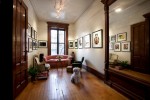
While most art galleries are located in spacious studio and loft spaces, Efron runs Ilon Art Gallery out of the late 19th-century brownstone she shares with her family at 204 W. 123rd St. in Harlem.

Efron has run a successful photo archiving business, Ilon & Company, for two decades — working with the likes of David LaChapelle and Annie Leibovitz — but in 2014 she expanded her business to include a gallery in her 4,500-square-foot townhouse that’s open to the public.

Modal Trigger
Gallery owner Loni Efron with husband Russ, kids Kami and Cody, and beloved Bo.Photo: Annie Wermiel/NY Post

“I had been collecting pieces for 20 years, hanging them on my walls, and they looked amazing,” says Efron, who also recently launched iArchive, a database management tool for photographers.

“So I decided, ‘Let’s do a show. Let’s make it a real gallery.’ ”

Fast forward two years and several installations later, and Efron’s current exhibition is “Music.”

Running until June 3, it features more than 70 snaps of iconic musicians shot by celebrity photographers.

They hang on walls throughout her four-story home.

The majority of the photos on view are in the parlor floor’s main room, which features soaring 11-foot-high ceilings. Highlights include David Bowie by Claude Gassian, Lady Gaga by Martin Schoeller and Keith Richards by Gered Mankowitz.

Read the entire article here: 

http://nypost.com/2016/03/24/this-harlem-brownstone-moonlights-as-a-groovy-gallery/

“It Happened in Havana: A Yiddish Love Story” a film by Judy Schiller will premiere on 4/14/16 at 10:30pm on Channel 13!

Posted on March 28, 2016 by APAG in News

Schiller7_17It Happened In Havana guide highlight

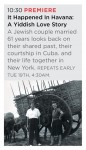
The film will premiere on Thursday, April 14, 2016 at 10:30pm on CHANNEL 13.

It will replay on Tuesday, April 19 at 4:30am.

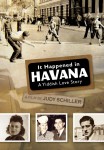
It Happened in Havana:

A Yiddish Love Story 

A film by Judy Schiller

He didn’t speak Spanish. She didn’t speak English. After 61 years of marriage he was still on his honeymoon.

In Forest Hills, Queens, a couple sits on their living room couch as the husband and wife each recount how they met in Cuba during the start of WWII.

In her cinematic debut, filmmaker Judy Schiller takes the viewer on two journeys: her mother’s, from Poland to Cuba, where she and her family were the only Jews in their town; and her father’s beginning on New York’s Lower East Side, where the street was the playground.

Equal parts romantic tale and history lesson, the film features poignant period footage and priceless home movies. The accompanying soundtrack intertwines Cuban and American music and enhances the couple’s affectionate dialogue.

How did they stay married for the 61 years? See their daughter’s tribute–and find out.

www.ithappenedinhavana.com


New US Postal stamp of Sarah Vaughan, photograph by Hugh Bell

Posted on March 23, 2016 by APAG in News
Sarah Vaughan – USPS First-Day-of-Issue Forever Stamp Ceremony
March 29th at The Newark Symphony Hall, Newark, NJ
In 2014, Gartenberg Media Enterprises was engaged on an exclusive basis by the Estate of Hugh Bell to manage the collection of Hugh Bell’s photographs and to further the artist’s legacy. We are therefore proud to announce the featuring of one of Hugh Bell’s iconic photographs of Sarah Vaughan on a USPS Commemorative Forever Stamp. The United States Postal Service is hosting a First-Day-of-Issue Stamp Ceremony for the release of the Sarah Vaughan Commemorative Forever Stamp at the Sarah Vaughan Concert Hall at Newark Symphony Hall in Newark, New Jersey on March 29th, 11am.
Above: Sarah Vaughan (Hugh Bell, 1955) and the Sarah Vaughan 2016 USPS Commemorative Forever Stamp
From The USPS Website:

“Sarah Vaughan was one of America’s greatest singers, successful in both jazz and pop, with a talent for improvisation and skillful phrasing and a voice that ranged over several octaves.

The stamp art is an oil painting of Vaughan in performance based on a 1955 photograph by Hugh Bell. A few lines of selvage text explain her importance as a Music Icon. The cover side of the pane features a larger version of the stamp art, a list of some of Vaughan’s popular songs, and the Music Icons logo.  Bart Forbes was the artist and Ethel Kessler was the art director. The 11 a.m. First-Day-of-Issue dedication ceremony will take place March 29 in Newark, NJ, at the Sarah Vaughan Concert Hall.”

Article by Stefani Twyford in www.femininecollective.com

Posted on March 12, 2016 by APAG in News

Creating My Father’s Legacy: Martin Elkort’s Photography

Martin Elkort 1950 ©Martin Elkort

Martin Elkort 1950 ©Martin Elkort

In the spring of 2014, I stepped up to a podium in the Brown Auditorium Theater of The Museum of Fine Arts, Houston. The place was full and the audience attentive, expectant. They had just seen my documentary, “Martin Elkort: An American Mirror” about my father, and I was unsure if I could make it through my speech. I had long focused my professional life on people’s life histories, on creating something they could leave as a legacy for future generations of their families. I had finally decided to do the same for my family while my parents were still alive and in good health. The process took eight years.

I began to record my parents sometime in 2006. They sat side-by-side on the sofa in my home as I interviewed each in turn. But when I turned the camera on my father, more often than not, my mother interjected, correcting him, and then Dad deferred to her “recollection of events.”  Worse, my mother had a long history of embellishing facts, which made it difficult to figure out what was the truth in what she said, and what was fantasy. Two years later, they came back to Houston to visit, and I tried to continue with them, but, this time, I was determined to get my father’s story in his voice.

I asked to interview Dad alone.

We covered many topics: general family history, what he knew of his parents and grandparents, his recollections of childhood, and his hospitalization with polio at fifteen. He talked about his early start as an artist and falling in love with photography.

To appease my mother, I did a few more interviews of her with my dad. It wasn’t apparent to me at the time, but looking back at the clips now, I see the signs of her impending dementia.

By then I had ten hours of video footage. I wasn’t sure what I was going to do with it all, but in my work, all too often I have raced against fading memories. I was well aware of the need to chronicle these stories while I still could. I was satisfied that I had captured some of our family histories, but the seed was planted for something more; I found my father’s story compelling, and important beyond our little family.

After his hospitalization with polio in 1944, Dad’s parents asked him what he wanted as a gift. He chose a single lens reflex camera. Costing more than a week of his father’s wages, this gift encouraged my father to get out and do something he enjoyed.

© Martin Elkort

© Martin Elkort

He took to walking the streets of New York City documenting the post-war boom. He loved to watch recent immigrants on the Lower East Side celebrate rebuilding their lives. Years later, reviews of his photography would point to the optimism of these photos during the post-depression period when it was easy to see only despair and decay.

Puppy Love 1951 © Martin Elkort

Puppy Love 1951 © Martin Elkort

read more here…

Creating My Father’s Legacy: Martin Elkort’s Photography

Martin Elkort documentary by Stefani Twyford and new book about children

Posted on March 12, 2016 by APAG in News

An American Mirror: The Movie

Children: Behind The Lens

Street Photography Capturing the Essence of Childhood

by Martin Elkort

Children Behind The LensIn the 1940’s and 1950’s, Martin Elkort roamed the streets of New York City with his camera in search of the perfect picture. His indelible images of simpler times remind us that the human experience can be a joyous one. Elkort was particularly drawn to the raw innocence of the children inhabiting the streets of New York, and later his current home, Los Angeles. Poignant and insightful, his photographs capture their curiosity and vigor as they explore the urban landscape. With an introduction by Anne Wilkes Tucker, Curator Emerita of Photography at The Museum of Fine Arts, Houston, this 69 page study of childhood features 62 of Elkort’s most intriguing black & white images of children punctuated with his eloquent reflections on photography and his creative process. This 9 x 9” offset print book will make a wonderful addition to any photographer’s book collection as well as anyone who enjoys experiencing the world through a child’s joyful eye.

“A beautiful photograph, like a beautiful poem, always contains a mystery, an elusive and haunting nucleus that makes us return again to probe its depths, hoping to winnow yet another insight.” – Martin Elkort

Educated at The Cooper Union, Elkort was also a member of the renowned New York Photo League where he studied under, and shared darkrooms with Aaron Siskind, Lou Stoumen and Sid Grossman, among others. He became adept at what he refers to as ‘stealth photography.’ With his camera strapped around his neck, he walked peering down into the 2×2 inch ground glass of the camera. He developed the skill of walking right up to a person and taking their photo without them even realizing it.

After marrying in 1953, he moved away from street photography in order to support his growing family. He journeyed back to it when he retired and found a growing interest not only in the Photo League, but in his own work as well.

Martin Elkort’s work is widely exhibited and can be found in the permanent collections of The Museum of Modern Art, The Getty Museum, The Museum of Fine Arts, Houston, The  US Holocaust Memorial Museum, The Jewish Museum in Brooklyn, The Columbus Museum of Art as well as many corporate and private collections.

Books


  • «
  • ‹
  • 11
  • 12
  • 13
  • 14
  • 15
  • ›
  • »

APAG

  • Home
  • About
    • APAG Board
  • Membership
    • Members Only
  • News
  • Resources
  • Members Gallery
  • Conference
  • Activities
  • Contact

Contact APAG

Contact APAG for membership, information, or with questions:

Visit our Contact Page »

Follow us on Facebook »

All photos on this website are protected by copyright of the individual photographers and archives whose photographs are represented. All rights reserved, and photos are not allowed to be used for any purpose without permission. Please write to the archives or photographers directly for permission requests.

(*) ©2026 APAG – American Photography Archives Group | Site by KPFdigital | Log in