
Creating My Father’s Legacy: Martin Elkort’s Photography

Martin Elkort 1950 ©Martin Elkort
In the spring of 2014, I stepped up to a podium in the Brown Auditorium Theater of The Museum of Fine Arts, Houston. The place was full and the audience attentive, expectant. They had just seen my documentary, “Martin Elkort: An American Mirror” about my father, and I was unsure if I could make it through my speech. I had long focused my professional life on people’s life histories, on creating something they could leave as a legacy for future generations of their families. I had finally decided to do the same for my family while my parents were still alive and in good health. The process took eight years.
I began to record my parents sometime in 2006. They sat side-by-side on the sofa in my home as I interviewed each in turn. But when I turned the camera on my father, more often than not, my mother interjected, correcting him, and then Dad deferred to her “recollection of events.” Worse, my mother had a long history of embellishing facts, which made it difficult to figure out what was the truth in what she said, and what was fantasy. Two years later, they came back to Houston to visit, and I tried to continue with them, but, this time, I was determined to get my father’s story in his voice.
I asked to interview Dad alone.
We covered many topics: general family history, what he knew of his parents and grandparents, his recollections of childhood, and his hospitalization with polio at fifteen. He talked about his early start as an artist and falling in love with photography.
To appease my mother, I did a few more interviews of her with my dad. It wasn’t apparent to me at the time, but looking back at the clips now, I see the signs of her impending dementia.
By then I had ten hours of video footage. I wasn’t sure what I was going to do with it all, but in my work, all too often I have raced against fading memories. I was well aware of the need to chronicle these stories while I still could. I was satisfied that I had captured some of our family histories, but the seed was planted for something more; I found my father’s story compelling, and important beyond our little family.
After his hospitalization with polio in 1944, Dad’s parents asked him what he wanted as a gift. He chose a single lens reflex camera. Costing more than a week of his father’s wages, this gift encouraged my father to get out and do something he enjoyed.
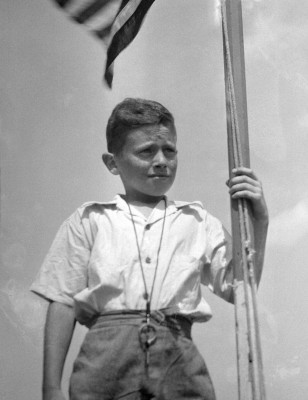
© Martin Elkort
He took to walking the streets of New York City documenting the post-war boom. He loved to watch recent immigrants on the Lower East Side celebrate rebuilding their lives. Years later, reviews of his photography would point to the optimism of these photos during the post-depression period when it was easy to see only despair and decay.
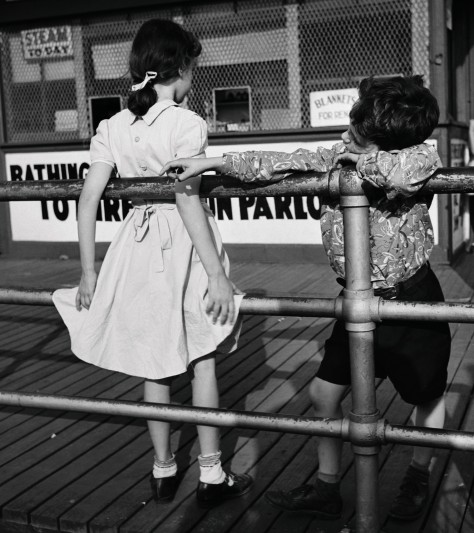
Puppy Love 1951 © Martin Elkort
read more here…