
Date: Sep 3, 2015 - Sep 30, 2015


It was a festive night at the Leica Gallery LA on September 3rd for the opening of Harold Feinstein’s Coney Island — the first exhibition since Harold’s passing on June 20th. There was a great turn-out over the course of the evening and gallery director, Paris Chong, commented that it was the best show since the gallery opened two years ago. The show, which will hang throughout September, also included Al Satterwite’s aRound New York series.
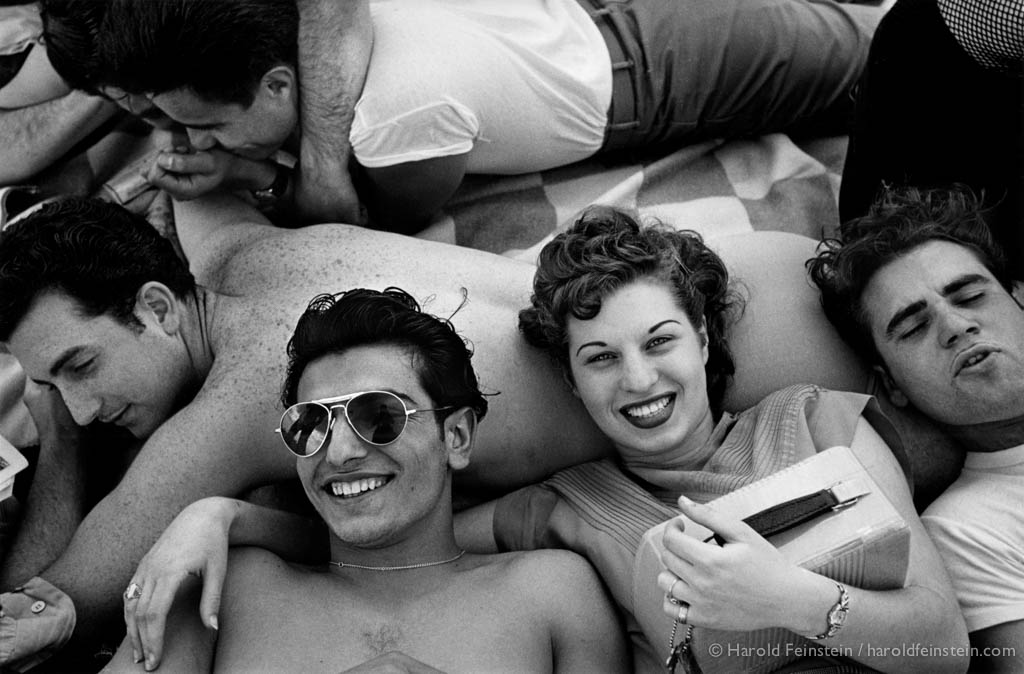
ARTIST STATEMENT
“I was born in Coney Island hospital in 1931, and I used to say that I dropped from my mother’s womb straight into the front car of the Cyclone roller coaster! As a boy my father would give me 25¢ for the day. A nickel would get me a ride on the trolley to Coney Island and for the rest of the day I’d use up the money on rides, attractions, and plenty of candy. I’d earn a little more to spend by drawing portraits on the boardwalk, then I’d hitch a ride on the back of the trolley hand get home penniless and happy!
I love Coney Island where it’s all hanging out and people are eating hot dogs and everyone’s being jostled by the crowd. I like to be so close. As you’re walking you’re involved in hundreds of conversations, a snatch here and a snatch there. You pass by an argument. You pass by someone laughing and two people necking and hugging each other. You pass by people rolling in the sand. In other words, there’s such a sense of involvement; such a sense of intimacy. It’s all hanging out and I love that and I love photographing that.
The question is not how you can get a great picture, it’s how you can avoid it! Every facet of the place calls out for attention – the beach, the boardwalk, the lovers, the families, the side-show, the water. There simply isn’t a moment where there is no picture.
Through the years people have asked me “are Coney Island’s best days in the past?” My answer is: “Right now in Coney Island is next year’s nostalgia. It’s great now, it’ll be great then!” I’ve been photographing there for sixty years and no matter how it changes, it’s always the same energy of vitality and enjoyment. Coney Island is a voyeur’s paradise.
HF – 2015
BIOGRAPHY
Harold Feinstein was born in Coney Island in 1931 and began photographing in 1946 when he was 15. By the time he was 19, his work was in the permanent collection at the Museum of Modern Art making him the youngest person to be so honored. He was also the youngest member of the Photo League, a designer for Blue Note records and one of the original inhabitants of New York’s legendary “Jazz Loft”. He began teaching before he was 30 and his legendary workshops have inspired hundreds of aspiring photographers. When he died recently (June 2015) the New York Times declared him “one of the most accomplished recorders of the American experience.”
He is best known for his Coney Island work, which spans six decades and intimately portrays the iconic American playground as a place of on-going exuberance and vitality regardless of the changes it has undergone over the years. Commenting on his one-man show, A Coney Island of the Heart, at the International Center for Photography in 1990, former New York Times critic, A.D. Coleman, remarked: “Here is New York small camera school at it’s best; humanistic, engaging, almost intrusive… this is the work of a man who loves people, takes unalloyed pleasure in seeing them enjoy themselves, likes to get close to them – and, by rendering their physicality in tactile, nuanced prints, enmeshes the viewer in the sensual, material world his ‘subjects’ occupy.”
His most recent book, Harold Feinstein: A Retrospective (Nazraeli, 2012) received a PDN Annual Best Photography Book Award in 2013. While his Coney Island work has been much celebrated, Feinstein’s breadth and exposure is far greater. His photographs from the Korean War, taken from the perspective of a draftee, offer an intimate look at the daily life of young conscripts from basic training to the front lines. In addition, he has a large collection of classic street photography, nudes, portraits and still life.
In addition to his classic black and white work, Feinstein devoted over a decade to color photography, both digital and film. In 2000 he received the Smithsonian Computerworld Award for his breakthrough work in scanography, which resulted in seven books including One Hundred Flowers, now in its third edition. Additional color work includes his photo-essay on Rodin’s sculpture and his series of abstracts of New York architecture, Metropolis, both created using color film.
His work is owned by museums and corporations worldwide including The Museum of Modern Art, The International Center for Photography, The George Eastman House, The Center for Creative Photography and The Museum of the City of New York.
Currently two documentaries of his life and work are underway and should be released in 2016.